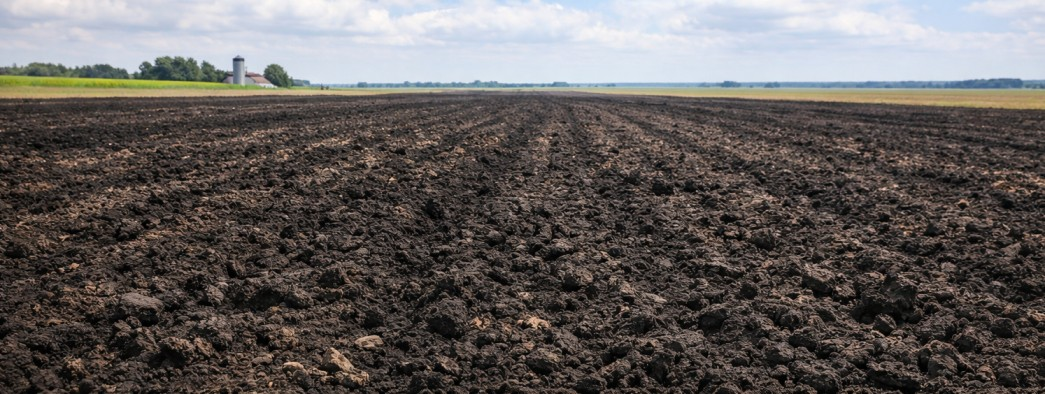
Black soils in India
"Soil can be defined as the organic and inorganic materials on the surface of the
Earth that provides the medium for plant growth".
Soil is a natural body
comprised of solids (minerals and organic matter), liquid, and gases that occurs on the
land surface, occupies space, and is characterized by one or both of the following:
horizons, or layers, that are distinguishable from the initial material as a result of
additions, losses, transfers, and transformations of energy and matter or the ability to
support rooted plants in a natural environment.
The upper limit of soil is the boundary between soil and air, shallow water, live
plants, or plant materials that have not begun to decompose. Areas are not considered to
have soil if the surface is permanently covered by water too deep (typically more than
2.5 meters) for the growth of rooted plants.
The lower boundary that separates soil from the non soil underneath is most difficult to
define. Soil consists of horizons near the Earth's surface that, in contrast to the
underlying parent material, have been altered by the interactions of climate, relief,
and living organisms over time. Commonly, soil grades at its lower boundary to hard rock
or to earthy materials virtually devoid of animals, roots, or other marks of biological
activity. For purposes of classification, the lower boundary of soil is arbitrarily set
at 200 cm.
The Indian Council of Agricultural Research (ICAR) set up an All India Soil Survey
Committee in 1953 which divided the Indian soils into eight major groups. They
are:
(1) Alluvial soils
(2) Black soils
(3) Red soils,
(4) Laterite and Lateritic soils
(5) Forest and Mountain soils
(6) Arid and Desert soils
(7) Saline and Alkaline soils
(8) Peaty and Marshy soils
This is a very logical classification of Indian soils and has gained wide acceptance.
A brief account of Black soils is given as under:
The black soils are also called regur (from the Telugu word Reguda) and black cotton
soils because cotton is the most important crop grown on these soils. Several theories
have been put forward regarding the origin of this group of soils but most pedologists
believe that these soils have been formed due to the solidifaction of lava spread over
large areas during volcanic activity in the Deccan Plateau, thousands of years
ago.
Most of the black soils are derived from two types of rocks, the Deccan and the Rajmahal
trap, and ferruginous gneisses and schists occurring in Tamil Nadu. The former are
sufficiently deep while the later are generally shallow.
Krebs holds that the regur is essentially a mature soil which has been produced by
relief and climate, rather than by a particular type of rock. According to him, this
soil occurs where the annual rainfall is between 50 to 80 cm and the number of rainy
days range from 30 to 50. The occurrence of this soil in the west deccan where the
rainfall is about 100 cm and the number of rainy days more than 50, is considered by him
to be an exception.
In some parts of Gujarat and Tamil Nadu, the origin of black cotton soils is ascribed to
old lagoons in which the rivers deposited the materials brought down from the interior
of Peninsula covered with lava.
Geographically, black soils are spread over 5.46 lakh sq km (i.e. 16.6 per cent of the
total geographical area of the country) encompassed between 15°N to 25°N latitudes and
72°E to 82°E longitudes. This is the region of high temperature and low rainfall. It is,
therefore, a soil group of the dry and hot regions of the Peninsula.
These soils are mainly found in Maharashtra, Madhya Pradesh, parts of Karnataka, Andhra
Pradesh, Gujarat and Tamil Nadu.
The black colour of these soils has been attributed by some scientists to the presence
of a small proportion of titaniferous magnetite or even to iron and black constituents
of the parent rock. The black colour of this soil may even be derived from crystalline
schists and basic gneisses such as in Tamil Nadu and parts of Andhra Pradesh. Various
tints of the black colour such as deep black, medium black, shallow black or even a
mixture of red and black may be found in this group of soils.
The black soil is very retentive of moisture. It swells greatly and becomes sticky when
wet in rainy season. Under such conditions, it is almost impossible to work on such soil
because the plough gets stuck in the mud.
However, in the hot dry season, the moisture evaporates, the soil shrinks and is seamed
with broad and deep cracks, often 10 to 15 cm wide and upto a meter deep. This permits
oxygenation of the soil to sufficient depths and the soil has extraordinary
fertility.
Remarkably "self¬ploughed" by loosened particles fallen from the ground into the
cracks, the soil "swallows" itself and retains soil moisture. This soil has been
used for growing a variety of crops for centuries without adding fertilizers and
manures, or even fallowing with little or no evidence of exhaustion.
A typical black soil is highly argillaceous with a large clay factor, 62 per cent or
more, without gravel or coarse sand. It also contains 10 per cent of alumina, 9-10 per
cent of iron oxide and 6-8 percent of lime and magnesium carbonates. Potash is variable
(less than 0.5 per cent) and phosphates, nitrogen and humus are low. The structure is
cloddish but occasionally friable.
In all regur soils in general, and in those derived from ferromagnesian schists in
particular, there is a layer rich in kankar nodules formed by segregation of calcium
carbonate at lower depths. As a general rule, black soils of uplands are of low
fertility but they are darker, deeper and richer in the valleys.
Because of their high fertility and retentivity of moisture, the black soils are widely
used for producing several important crops. Some of the major crops grown on the black
soils are cotton, wheat, jowar, linseed, Virginia tobacco, castor, sunflower and
millets. Rice and sugarcane are equally important where irrigation facilities are
available. Large varieties of vegetables and fruits are also successfully grown on the
black soils.
Important features of black soil:
• Regur means cotton – best soil for cotton cultivation.
• Most of the Deccan is occupied by Black soil.
• Mature soil.
• High water retaining capacity.
• Swells and will become sticky when wet and shrink when dried.
• Self-ploughing is a characteristic of the black soil as it develops wide cracks
when dried.
• Rich in: Iron, lime, calcium, potassium, aluminum and magnesium.
• Deficient in: Nitrogen, Phosphorous and organic matter.
• Colour: Deep black to light black.
• Texture: Clayey.
Map showing Black cotton soils in India
Assistant Professor of Agronomy
Padmashree Dr. Vithalrao Vikhe Patil Foundation's College of Agriculture,
Ahmednagar
Contact: 9420396920, Email: hlshirsath [at] gmail.com
Black Soil Characteristics and Constraints
The soils developed on schists and gneisses and are moderately shallow (50-75 cm) to moderately deep (75-100 cm) where as those developed on basalt are deep (100-150 cm) to very deep (>150 cm). These soils are highly argillaceous with clay content varying from 30-80%.
Introduction of Black Soil
Black soil in India is rich in metals such as Iron, Magnesium and Aluminum. However it is
deficient in Nitrogen, Potassium, Phosphorous and Humus. Black soil is of red colour mainly
due to its iron oxide content. This soil shares 15 % of all types of soil in India. These
soils are made up of volcanic rocks and lava-flow. It is concentrated over Deccan Lava Tract
which includes parts of Maharashtra, Chhattisgarh, Madhya Pradesh, Gujarat, Andhra Pradesh
and Tamil Nadu.
Typical characteristics of this black soil are swelling (during wet period) and shrinkage
(dry period). While dry, it forms very deep cracks of more than 30-45 cm. In Kovilpatti
(Tamil Nadu) areas the cracks may extend to 2 to 3 m with a width of 1 to 6 cm. Field
preparations takes longer time compared to other soil. Only after secondary tillage, the
soil is suited for crop production.
The soils are fine grained contain high proportion of Calcium and Magnesium carbonates. Black soil holds more moisture and available for a long time.In Tamil Nadu Black soils have high pH (8.5 to 9) and are rich in lime (5-7%), have low permeability. The soils are with more cation exchange capacity (40-60 m.e./100 g). Crops cultivated from this type of soil are Rice, Ragi, Sugarcane and Cashew nuts etc. This type of soil formed as a result of high leaching and found in the areas of high rainfall.