Crop Information
Jowar (Sorghum): A Low-Risk Crop for Drylands — But Don't Expect Windfall Profits
Jowar is one of India's most reliable dryland cereals. It is hardy, climate-resilient, and input-light. Farmers grow it not to gamble on prices, but to secure fodder, food, and minimum income under uncertain rainfall.
Jowar is about stability, not speculation.
Crop Guide · IndiaAgroNet Editorial Team
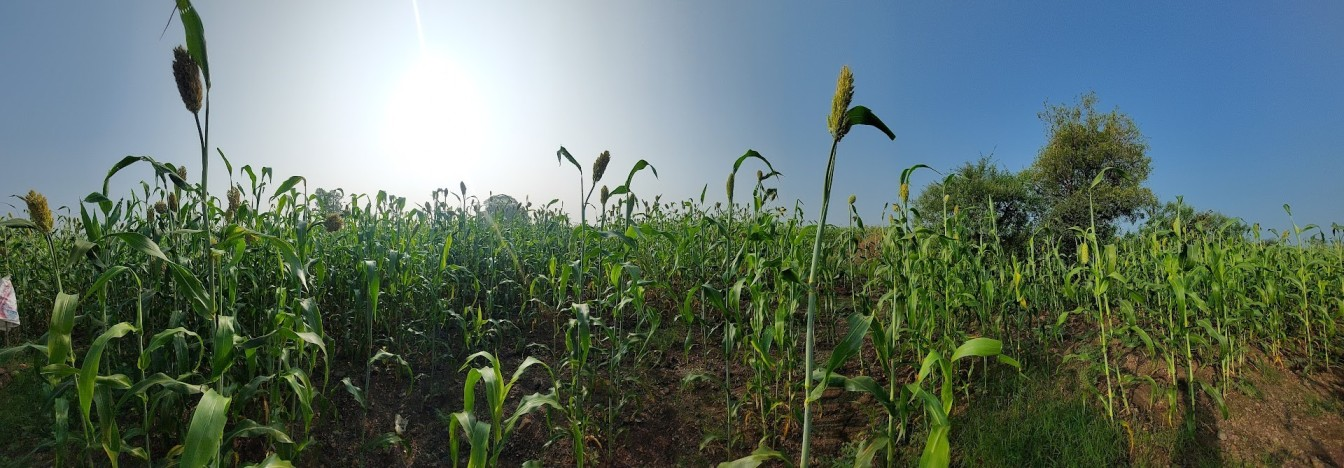
Figure: Jowar is a hardy dryland crop that provides both grain and fodder security.
1. Benefits of Sowing Jowar
Jowar remains a preferred crop in dry and semi-arid regions for practical reasons.
| Benefit | What It Means for Farmers |
|---|---|
| Excellent drought tolerance | Survives erratic rainfall |
| Low input requirement | Lower cost than maize/wheat |
| Dual purpose crop | Grain + fodder |
| Short to medium duration | 90–120 days |
| Heat tolerance | Suitable for climate stress |
| Household food security | Staple grain in many regions |
2. Key Challenges & Limitations
Jowar is safe—but not high-return.
| Challenge | Impact |
|---|---|
| Low market price | Limited upside |
| Weak private demand | Mostly local consumption |
| MSP procurement limited | Market dependence |
| Bird damage | Yield loss near maturity |
| Labour at harvest | Cost pressure in some areas |
3. Cost of Cultivation (Indicative – Per Acre)
Rainfed conditions
| Cost Component | ₹ / Acre |
|---|---|
| Seed | 600 – 900 |
| Land preparation | 2,000 – 3,000 |
| Fertilizers | 1,200 – 1,800 |
| Plant protection | 800 – 1,200 |
| Labour | 2,500 – 3,500 |
| Total Cost | 7,000 – 10,000 |
4. Yield & Price Scenarios
Yield Range (Per Acre)
| Condition | Yield (Quintals) |
|---|---|
| Poor rainfall | 5 – 6 |
| Average | 7 – 9 |
| Good management | 10 – 12 |
Market Price Range
| Market Situation | ₹ / Quintal |
|---|---|
| Local mandi | 2,200 – 2,800 |
| MSP zone | 3,000 – 3,200 |
| Specialty demand (urban/organic) | 3,500 – 4,500 |
5. Profitability Indicators
Net Profit per Acre (Indicative)
| Yield | Price | Net Result |
|---|---|---|
| 6 qtl | ₹2,400 | Break-even |
| 8 qtl | ₹2,800 | ₹10,000–12,000 |
| 10 qtl | ₹3,000 | ₹18,000–20,000 |
| 12 qtl | ₹3,500 | ₹30,000+ (rare cases) |
ROI (Return on Investment)
| Yield Level | ROI |
|---|---|
| Poor | 0–20% |
| Average | 60–100% |
| Good | 150–200% |
6. When Jowar Makes Sense
Grow Jowar If:
- Rainfall is unreliable
- Soil fertility is low to medium
- Fodder requirement is high
- Risk appetite is low
- Household grain consumption matters
Avoid Jowar If:
- You target high cash profits
- You depend on distant mandis
- You have assured irrigation (better crops available)
- Labour cost is very high
7. Smart Farmer Practices
| Practice | Benefit |
|---|---|
| Early sowing with monsoon | Better grain filling |
| Improved hybrids/varieties | Higher yield stability |
| Line sowing | Easier weeding |
| Bird scaring at maturity | Prevent losses |
| Fodder planning | Extra income security |
Farmer Verdict (Straight Talk)
- Jowar will not make you rich
- Jowar will keep you safe
It is best suited for farmers who value:
- Stability over speculation
- Fodder + food security
- Climate resilience
In uncertain years, Jowar beats crop failure.
Disclaimer
All information provided in this article is for general informational purposes only. Crop costs, yields, prices, and profitability figures are indicative and may vary based on location, soil type, rainfall, farming practices, market conditions, and government policies.
This content does not constitute professional agricultural, financial, or investment advice. Farmers are advised to consult local agriculture officers or experts and assess current market conditions before making sowing or input decisions.
The publisher assumes no responsibility for losses or damages arising from decisions taken based on this information.
Crop Cultivation Guidence: Jower Cultivation
Introduction:
Sorghum (Sorghum vulgare Pers.),
popularly known as jowar,
is the most important food and fodder
crop of dryland agriculture. The annual
area under
it ranges between 17 and 18 million
hectares and the annual production
between 8 and 10
million tonnes.
Sorghum is
originated in India and Africa. It is
also said that its
origin is Abyssinia and from there it
was brought to USA and European
countries.
Jowar is
mainly concentrated in the peninsular
and central India. Maharashtra,
Karnataka, Andhra Pradesh, Madhya
Pradesh, Gujarat, Rajasthan, Uttar
Pradesh (the Bundelkhand region) and
Tamil Nadu are the major jowar –
growing states.
Other states grow sorghum in small areas
primarily for fodder.
The
sorghum
grain is used primarily as human food in
various forms, such as roti or
bhakri (unleavened
bread), or is cooked like rice. Sorghums
are also malted, popped and several
local
preparations are made. Green and dried
fodder is the most important roughage
for feeding
cattle throughout the country. The
utilization of grain sorghum as a cattle
feed, poultry
ration and other industrial uses is at
present not very significant, although
considerable
scope exists.
Climate and soil:
Sorghum plants are very hardy and can
withstand high temperature and drought,
however, it is grown in arid regions of
U.P, Rajasthan and humid regions of
Bengal and Bihar. It may be successfully
grown under atmospheric temperature
ranging between 15 0C to 40
0C and annual rainfall
ranging from 400 to 1000
mm.
Sorghum is grown on a
variety of soil types but the clayey
loam soil rich in humus is found to be
the most ideal soil. It may tolerate
mild acidity to mild salinity under pH
5.5 to 8.0. A good sorghum soil must
have an efficient drainage facilities
though, it may withstand water logging
more than maize.
Land Preparation:
Deep summer ploughing with mould board plough soon after rabi crop is harvested and leaving the soil exposed to sun until onset of monsoon is a common practice. With the onset of monsoon the land should be ploughed twice by country plough. But the soil for grain crop should be pulverised for a fine tilth by harrowing and cross plankings. If desired, field should be levelled before sowing so that rainwater may be well distributed throughout the field.
Improved and Hybrid varieties of Sorghum:
| KHARIF
SORGHUM A. Improved varieties |
||||
|---|---|---|---|---|
| S.N. | Varieties | Parents | Days to maturity | Yield (T/ha) |
| 1 | SPV-462 | 110 - 115 | 35 - 40 | |
| 2 | CSV-13 | 110 - 115 | 35 - 40 | |
| 3 | CSV-15 | SPV-475X SPV -462 | 110 - 115 | 40 - 45 |
| B. Hybrid varieties | ||||
| 1. | CSH-1 | CK 60A x IS 84 | 90 - 100 | 30 - 35 |
| 2. | CSH-5 | 2077A x CS 3541 | 110 - 115 | 40 - 45 |
| 3. | CSH-6 | 2219 A X CS 3541 | 90 - 100 | 50 - 60 |
| 4. | CSH-9 | 296 A x CS 3541 | 110 - 115 | 45 - 50 |
| 5. | CSH-10 | 296 A x SB 1085 | 110 - 115 | 45 - 50 |
| 6. | CSH-11 | 296 A x MR 750 | 110 - 115 | 45 - 50 |
| 7. | CSH-14 | AK MS 14 A x AKR150 | 100 - 105 | 45 - 50 |
| RABI
JOWER A. Improved varieties |
||||
| 1. | M-35-1 | 120 - 125 | 15 - 18 | |
| 2. | CSV-8R | 120 - 125 | 20 - 22 | |
| 3. | Swati | M-35-1 x SPV 36 | 120 - 125 | 24 - 28 |
| 4. | CSV-14R | 115 - 120 | 20 - 24 | |
| 5. | Selection 3 | 105 - 110 | 5 - 6 | |
| 6. | SPV-1359 | 125 - 130 | 25 - 30 | |
| B. Hybrid varieties | ||||
| 1. | CSH-13R | 296 A x RS 29 | 115 - 120 | 25 - 30 |
| 2. | CSN-15R | 104 A x RS 585 | 115 - 120 | 32- 35 |
| 3. | Phule Yashoda | 120 - 125 | 18 - 20 | |
| 4. | SPV-84 | 120 - 125 | 20 - 22 | |
Sowing:
a) Sowing time:Sorghum crop is grown
in almost all the seasons of the year.
In
Northern India conditions it is grown in
kharif season but in Southern India the
crop is
grown during Rabi and summer seasons.
Kharif crop should be sown soon after
first break of
monsoon rains i.e. nearly in last week
of June. Therefore, the best sowing time
is in last
week of June to first week of July
depending upon onset of monsoon. Whereas
rabi jawar is
sown in the month of October to
November.
b) Spacing:A spacing of 40-45 cm
between the rows and 15-20 cm between
the
plants is quite
satisfactory.
c) Seed rate:
Required plant population may be
obtained by using a seed rate of 8-12
kg/ha. The seeds are sown about 3-4 cm
deep in the furrows.
Seed treatment:
The seed treatment may be done by Agrosan GN, Thiram at the rate of 3g/kg of seed or sulphur at the rate of 5g/kg of seed. The seed is treated, dried and sown in the field.
Application of mannurs and fertilizers:
Sorghum is an exhaustive crop and it depletes soil fertility very fast, if proper care is not taken. The fertilizer doses differ from type to type and nature of crop to be grown e.g. local varieties need less quantity than hybrid ones. Similarly, irrigated crop requires higher doses than rainfed ones no matter whether it is a local or high yielding variety. Considering all these points an optimum dose may be found out from the following details: an optimum dose of nitrogen for rainfed high yielding and local varieties of irrigated crop should be 60-80kg/ha while for irrigated high yielding varieties it should be between 120-150 kg/ha. In case of heavy soils one single application gives better results than split application but in case of light soils split application i.e. half basal and remaining half as top-dressing at knee-height stage or 30-35 days after sowing is preferred. Under low rainfall or in rainfed areas top-dressing of nitrogen is not required. On an average a dose of 40-60 kg P2O5/ha is found to be good. Placement at 4-6 cm depth has given better results. However, under normal conditions it is mostly basal placed. Potash at the rate of 40kg/ha applied at the time of field preparation gives good result.
Interculture :
Manual weedings and hoeings help in solving the weed problem but it is possible only during rabi and arid cropping seasons while rains do not permit the manual weeding or hoeing during kharif season. Application of herbicides like atrazine @ 0.5 kg a.i./ha or Propazine @1.0 kg a.i./ha dissolved in 900-1000 liters of water, therefore, becomes obviously essential to control weeds. These herbicides should be applied before emergence of sorghum seedlings.
Irrigation:
Sorghum is a fairly drought resistant crop and it does very well in areas receiving 50 cm well distributed rainfall but it cannot withstand waterlogging at any stage of crop growth. The most critical growth stages for irrigation are knee-height stage, flowering and grain filling stages at which the crop should be ensured for proper moisture conditions so that the crop does not suffer from moisture stress.Contrary to this in kharif crop an efficient drainage must be provided as the crop cannot tolerate water accumulation for more than few hours, therefore, in low lying areas sowing of crop on 5-7cm high ridges or sowing in flat beds followed by light earthing is a remedy for stagnant water in the field.
Plant protection Measures:
Sorghum is found to be attacked by shoot-fly,
stem-borer and midges mainly and they
cause a considerable reduction in grain
and stover yields. Following schedule
may help in their control:
A. Schedule of operations for control
for insect/pest in sorghum
crop
| Insect | Growth stage at which they attack | Control measures | |
|---|---|---|---|
| Chemical | Preventive | ||
| Shoot- fly | Seedling stage | Carbofuran
@ 1kg/100kg of seed, or
5% Disulfoton @ 3g/m row
length, or 10% phorate
grannule @ 5 g/m
row length may be sown
along with
seeds. Or Spraying of Carbaryl (50%w.p) or Endrin (20% EC @ 2 kg or 1 kg/ha respectively twice i.e. 3-5 DAS & 8-12 DAS. |
Use of higher seed rate removal & destruction of damaged seedlings 10-12 days after germination. |
| Stem borer | Seedling to flowering stage | Application of grannules of any of 4% Edosulfan @ 8kg/ha, 4% Carbaryl @ 12kg/ha or 2% Lindane @ 15 kg/ha in leaf whorls twice at 10 days interval starting from 20 days after germination. | Uprooting and burning of stubbles. |
| Midge | Panicle emergence to flowering | Spraying of Carbaryl (50%W.P) @ 3 kg/ha or Lindane (20EC) @ 1.25 litre or Endosulfan (30 EC) @ 1 litre in 500-600 litres of water/ha before flowering or 3 days after panicle emergence controls the insect. | Buming of panicle residues and chaff left after threshing. |
B. Disease and their control
| Diseases | Causal organism | Control measures |
|---|---|---|
| Grain smut | Sphacelotheca sorghi | Seed treatment with organo-mercurial compound viz. Ceresan, Agrosan GN, etc. |
| Ergot | Sphacelia sorghi | 1. Seed treatment with any
of the above-mentioned
chemicals. 2. Spraying of Ziram @0.15% or 1 kg/ha at boot leaf stage and its repetition at 5-7 days interval at least two times. 3. Immersion of seed in 2% saline water, washing them with fresh water and drying in shade controls the disease. |
| Downy midew | Sclerospora sorghi | 1. Avoid
waterlogging. 2. Removal and burning/burying of diseased plants. 3. Application of Dithane Z-78 @ 0.2 % spray solution reduces secondary infaction. |
Harvesting and threshing:
a) Harvesting
The high yielding
varieties mature in about 100-120 days
duration
after which they are harvested.
Generally two methods of harvesting i.e.
either stalk-cut
or cutting of earheads by sickles are
employed. However, in foreign countries
sorghum
harvesters are used. In case of stock
cut method the plants are cut from near
the ground
level, the stalks are tied into bundles
of convenient removed from plants, while
in later
case the earheads, after their removal
from the standing crop, are piled up on
the
threshing floor and after few days they
are threshed. Threshing of earheds is
done either
by beating them with sticks or by
trampling them under bullock’s
feet. Later method
is quicker and is practiced by majority
of farmers who use to grow the crop on
larger
scale.
b) Yield
The grain yield of
improved varieties under assured water
supply
ranges between 25-35 quintals/ha and
that of hay or karvi between 150-170
quintals/ha.
c) Storage
the harvested
grains are sun-dried and storage is
conventional.