Disease Name |
Picture
showing disease |
Causal |
Symptoms |
Control Measures |
Anthra |
Glomerella |
All the above ground parts of the plant are attacked; infection on the seedlings and bolls is serious; large red spots appear on the seedlings; later, they girdle the stem and kill it. |
Treat
the seed |
|
Leaf |
|
Helminth- |
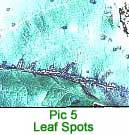
Helminthosporium spots are light brown, circular and numerous, the centre of the spot later turns ashy and falls off, leaving a hole; Alternaria spot is typified by an abundance of papery, rusty brown spots of irregular size and shape; Cercospora leaf spots are small and irregular and have a purple border and a white centre. |
Spray the crop with 0.3% fixed copper or 0.2% Zineb. |
Grey |
Ramularia |
A whitish growth appears chiefly on the undersurface of the leaves. |
Spray the crop with 1% Bordeaux mixture or with any fixed copper fungicide, (0.3%) |
|
Powdery |
Leveillula |
White powdery patches appear on the undersurface of the leaves; the corresponding upper portions just above patches become pale and brown. |
Dust the crop with finely powdered sulphur @ 15 kg per hectare. |
|
Dry
root |
Macro- |
Large brown lesions are formed in the collar region; the vascular zone of the roots is discoloured brown; rootlets rot and the plants dry up. |
Practise crop rotation; grow resistant varieties. |
|
Root |
|
Rhizocto- |
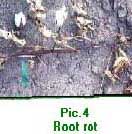
Plants wilt suddenly; roots rot and show the shredding of the bark; the disease occurs in patches; affected plants can be easily pulled out. |
Sow cotton early (1st week of April) or very late (1st week of June); practise mixed sowing with moth (Phaseolus aconitifolius) in infected areas. |
Wilt |
|
Fusarium |
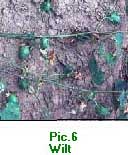
Leaves yellow and dropping; plants stunted, gradually wilt and die, the vascular tissue become brown; only scattered plants are affected. |
Grow resistant varieties. |
Verti- |
|
Verticillium |
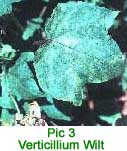
The yellowing of cotyledons and stunting; the outstanding symptom is the mottled appearance of the leaves with yellow areas developing between the veins and on the margins; brownish discolouration of the woody stem, which is usually more evenly distributed through the stem centre (stele) and lighter brown than the discolouration caused by the Fusarium wilt. |
Grow resistant varieties, spot application of wet Ceresan @ 0.1% (6.5 kg of wet Ceresan per ha before planting). |
Sclero- |
Pellicularia |
A white weft of mycelium is formed near the base of the plant on which white to raddish-tan spherical sclerotia appeared. |
Crop rotation and sterilize the soil. |
|
Rust |
|
Cerotelium |
Innumerable, small, yellowish brown rust pustules are formed on the leaves. |
The disease is occasionally serious. |
Bacterial |
|
Xamtho- |
All the aboveground parts are attacked; lesions on leaves are angular and water-soaked; they turn dark brown, when old; lesions on the stem are long and dark. |
Treat acid-delinted seed with an organo-mercurial (Agrosan GN or Ceresan) at 2-2.5g per kg or Agrimycin-100 (100 ppm), spray with 0.3% copper fungicide; Agrimycin 100 + Copper or Oxycarboxin (1.5-2 kg/ha); grow resistant varieties. |
Stenosis |
Virus |
Small leaf is characterized by an extreme stunting of the aerial organs; leaves are variously lobed; flowers very small and bolls are never formed. |
Grow resistant varieties. |
|
Tirak
(prem- |
Physio- |
The early yellowing; dropping and shedding of leaves; bolls crack; do not open properly; seeds remain immature, lint quality greatly reduced. |
Sow late (June); apply extra water at flowering and fruiting on light sandy and alkaline soils. |
|
Red leaf |
Physio- |
Occurs on American varieties; leaves turn yellow or red and roll downwards; when severely affected, the whole lamina becomes red leaving the veins green; leaves dry up and are shed. |
Proper manuring; growing of resistant varieties. |
|
| Seedling Disease
A soft, watery |
|
Pythium spp.,
Rhizoctonia solani, (These
disease- |
Seed decay, decay of the seedling before emergence, partial or complete girdling of the emerged seedling stems, and seedling root rot. Damaged seedlings are pale, stunted, slower growing, and sometimes die within a few days. R. solani and P. exigua may attack seedlings from the time they emerge until they are about 6 inches tall. After this stage, the stem becomes woody, and subsequent infection rarely occurs unless the stem is injured. Phoma exigua (Ascochyta), and Fusarium spp.Cause post-emergence damping-off. Premature dying of cotyledons, which turn brown and shrivel; |
Fungicides containing PCNB (Terrachlor) or Iprodione (Rovral) are generally effective against Rhizoctonia solani. Fungicide effectiveness against P. exigua has not been evaluated. Use (certified seeds) quality seed with high germination potential. Plant only fungicide-treated seed. Applied fungicide and seed should be properly layered. protectants fungicides, such as captan or Thiram, Systemic fungicides, such as carboxin (Vitavax) provide temporary protection from certain types of pre-emergence and post-emergence damping-off. Use an in-furrow granular fungicide (Thimet). Granules should be placed in the bottom of the seed furrow and mixed with the covering soil. Crop rotations, Proper fertilization, avoid excessive rates and deep incorporation of herbicides, good seedbed e.g. raised beds in early planted cotton are other control measures. |
| In-furrow (soil) application of fungicides against seedling disease | ||||
| Fungi- cides |
Form | Application |
Control | |
PCNB
(Terraclor) |
10G,15G,75WP, 2EC 10+2.5G, 15+3.8G |
140-250 |
Effective against Rhizoctonia. Effective
against |
|